
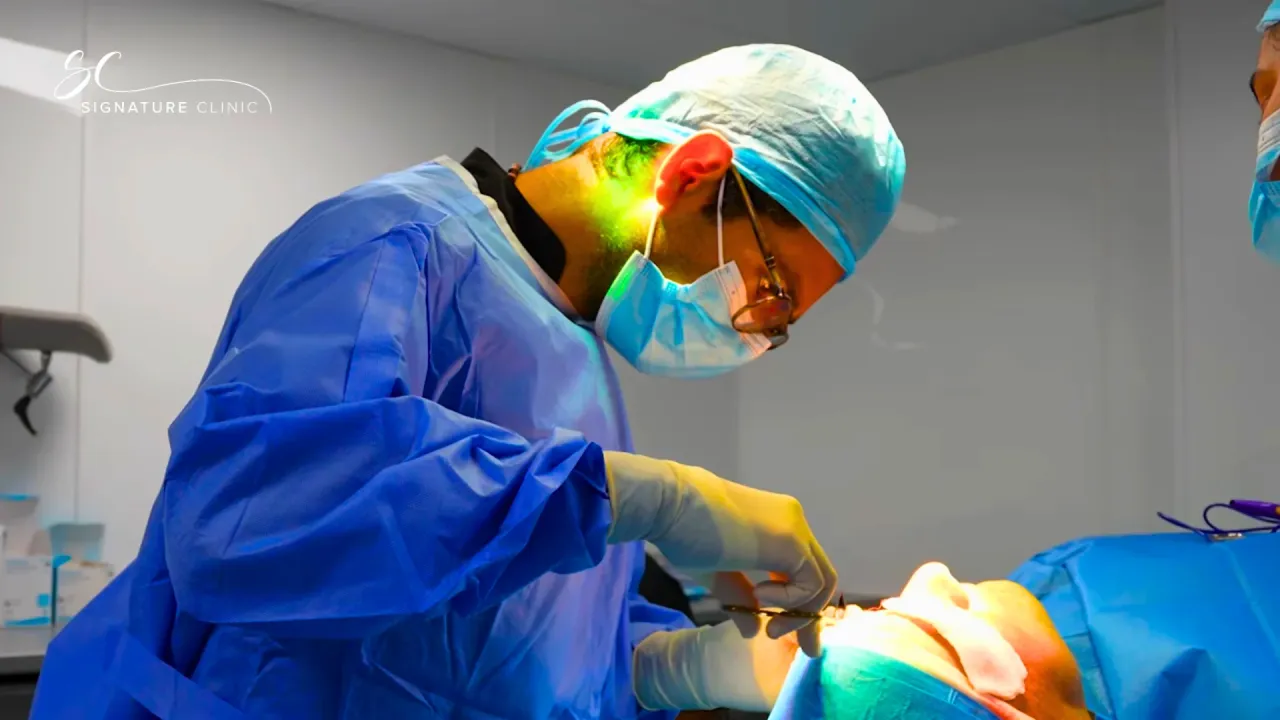
If you have been considering upper eyelid surgery but are not quite sure what to expect on the day, this is the blog for you.
Dr Carlo Debbas, Consultant Cosmetic Surgeon at Signature Clinic, performs upper blepharoplasty every single day. In the video below, he walks through the entire procedure himself, in his own words, explaining exactly what he does and why at every step.
It is one of the most transparent and honest accounts of eyelid surgery you will find anywhere. If you have questions, this video likely answers them.
Dr Debbas opens the video with something that immediately puts patients at ease. Upper blepharoplasty is not a procedure he performs occasionally. It is one he carries out multiple times, every single day. That level of repetition matters. It means every decision he makes during your procedure, from the surgical markings to the stitch choice, is one he has made thousands of times before.
He describes it as a very safe procedure, performed comfortably under local anaesthetic, meaning you are fully awake but feel no pain at all.
What if you are nervous about being awake?
This is one of the most common concerns patients raise before booking, and Dr Debbas addresses it directly.
For patients who feel anxious about being awake during the procedure, Signature Clinic offers oral sedation. A diazepam tablet is prescribed in advance, you bring it with you on the day, and the team allows around 30 minutes after informed consent is signed for it to take effect. Only once you feel relaxed does the procedure begin.
It is a small but meaningful detail that reflects how the clinical team approaches patient experience at Signature Clinic.
The surgical markings, the most important step

Once in the operating theatre, the first thing Dr Debbas does is disinfect the face and make the surgical markings. He is clear about why this matters so much.
“Every millimetre counts, especially in the upper eyelids.”
The markings determine exactly how much skin is removed. Too little and the result will be underwhelming. Too much and the patient will not be able to fully close their eyes. Getting this right requires experience, precision, and an eye for the individual anatomy of each patient. It is not something that can be rushed or templated.
Local anaesthetic, what you will actually feel

After the markings are set, Dr Debbas numbs the eyelids. He explains exactly what patients experience at this stage, which most surgeons do not take the time to do.
You will feel a sharp scratch as the local anaesthetic goes in, followed by a cold or wet sensation beneath the skin. Within two to three minutes, the area is fully numb and the procedure can begin.
He also explains something that catches many patients off guard. The local anaesthetic contains adrenaline, which is essential for minimising bleeding during this delicate procedure. A few minutes after injection, your heart rate may increase and you might feel a slight shiver. This is entirely normal and not a cause for concern. Dr Debbas tells his patients to expect it so that it does not feel alarming when it happens.
The procedure itself, what Dr Debbas does and why

Once he is satisfied the eyelids are fully numb, Dr Debbas makes the incision and removes the excess skin. He makes a point of sharing his philosophy here, which differs from some surgeons.
He does not remove the muscle. He is clear about this. In his view, the muscle is too important to excise, and removing it unnecessarily can cause weakness and potential ptosis (drooping) in some patients over time. His approach is conservative, precise, and focused on the long-term outcome.
He also addresses fat removal carefully. Excess fat pads, typically located near the nose and centrally, are trimmed only where necessary. Removing too much fat can cause a hollow appearance in the upper eyelids, or a specific deformity known as an A-frame deformity. Every decision about fat is calculated with the natural shape of the eye in mind.
Stitches, dissolving or non-dissolving?

Once the skin has been removed and bleeding controlled, Dr Debbas closes the incision with sutures. He gives patients the choice of dissolving or non-dissolving stitches, and he is straightforward that neither is objectively better than the other.
Dissolving stitches: no return visit needed for removal, but they remain on and beneath the skin for two to three weeks. If they have not fully dissolved by then, the clinic will remove them.
Non-dissolving stitches: require a return visit five to seven days after surgery. For patients who prefer a clean, quick resolution, this is often the preferred option.
The choice depends on lifestyle, previous experiences, and personal preference. Your surgeon will discuss both at your free consultation.
What makes this video worth watching
Most cosmetic surgery content online is promotional. This is not that. Dr Debbas is talking through his own clinical thought process in real time, explaining the decisions he makes during a procedure he has performed more times than most surgeons in the UK.
If you are considering upper blepharoplasty and want to know what will actually happen on the day, watching this video is the best preparation you can do before your consultation.
Upper blepharoplasty at Signature Clinic
Upper blepharoplasty at Signature Clinic is performed by GMC-registered consultant surgeons across 10 regulated UK clinic locations. The procedure is available under local anaesthetic as a day case, with general anaesthetic also available.
Pricing starts from £2,395 under local anaesthetic. General anaesthetic pricing is confirmed at consultation.
For a full breakdown of procedure options, pricing, and recovery, visit the blepharoplasty procedure page.
To book your free, no-obligation consultation with Dr Carlo Debbas or another member of the surgical team, book here.
Please refer to our pricing page for the most up-to-date figures, as prices may be updated from time to time.
Frequently asked questions
Is upper blepharoplasty painful?
No. The procedure is performed under local anaesthetic, meaning you are fully awake but will not feel any pain. You may feel a sharp scratch when the anaesthetic is administered, but once it takes effect the procedure is comfortable throughout. Oral sedation is also available for patients who feel anxious about being awake.
How long does upper blepharoplasty take?
When can I go back to work after upper blepharoplasty?
Do I need to come back to have stitches removed?
It depends on the type of stitches used. Dissolving stitches do not require removal. Non-dissolving stitches are removed at a follow-up appointment five to seven days after surgery. Your surgeon will discuss the options with you at consultation.
Who performs upper blepharoplasty at Signature Clinic?
Upper blepharoplasty at Signature Clinic is performed by a team of GMC-registered consultant surgeons including Dr Carlo Debbas, Dr Sherif Elamari, Dr Mohamed Abdelhady, Dr Anan Ibrahim, Dr Huseyin Can Yucel, Dr Ayman Mohammad, Dr Bikram Jit Singh, and Dr Ahmed Shedid.
How much does upper blepharoplasty cost?
At Signature Clinic, upper blepharoplasty starts from £2,395 under local anaesthetic. Please refer to our pricing page for the most up-to-date figures.
This article has been reviewed and approved by Dr Carlo Debbas, Consultant Cosmetic Surgeon at Signature Clinic. It is intended for informational purposes only and does not constitute medical advice. Individual suitability for surgery should always be assessed in a clinical consultation.


